I will be wrestling all summer with the question
"How do you teach music online?"
And no, I don't even mean Applied Music. There are definitely some issues and questions that arise with that one. I am referring to teaching "about" music. Or, more specifically, a Music Appreciation class.
For me, the main objective in a Music Appreciation class is to have the students come away with a new ability to listen to music. You see, most students who are non-musicians (and even some who are) do not actually listen to music. Oh, they hear it all right. It is on all the time. Usually too loudly and in situations where its broadcast is inappropriate. (No, I do not want to listen to your favorite R&B artist's newest "romance" song on your tinny sounding iPod speakers in the gym locker room, thank you.) But to hear the elements of music at all is not a skill that most of my students have even thought to develop.
But how can you teach the requisite skills in an online environment?
The easiest thing in the world is to make Music Appreciation a glorified music history class for non-majors. It satisfies all the i-dotters and t-crossers in the assessment game. It is clear-cut information that the instructor has and the student does not. But when it is limited to that kind of exchange, I think it misses the point. The better and more fun class is where a student learns HOW to listen.
I think the basic element of this process is structure. The bones of any musical piece. That is my next piece to chew on.
Wednesday, June 5, 2013

Tuesday, January 8, 2013
Les Miserables (the film) – My take
First of all, is there anything better than going to a movie
in the middle of the day? I think not. Add in some of your best girlfriends,
and this is already a good experience.
The film as a whole
… was epic. From visually stunning to gorgeously scored, the
film tells the story of the suffering and generally unfair lives of the poor
souls who had the misfortune to live at this time in history. Nobody escapes
your eventual sympathy. Even Javert, who I always hated, gets a little
bit of understanding from me in this film. The technical aspects of the movie-making
unobtrusively help with the storytelling here. The obviously squalid conditions
of the places where our characters existed hit just the right note so that you
understood but they didn’t take over the story and make it about the conditions. (I mean, you could almost smell the sewer on
Valjean in that scene at the end. Yuck!)
I also liked that they didn’t apologize in any way for this
being a SUNG musical. Almost every line is sung. Did you notice that? Very,
very few spoken lines. You have probably already heard that instead of recording
the soundtrack in a studio ahead of time and lip-synching the filming, they fed
live piano accompaniment to the actors through ear pieces and recorded their
singing on set while they were acting the scene. An unusual, if
not brand new as they claim, practice, this gave authenticity and immediacy
to the vocal performances which is, in my view why the film succeeds so
strongly. And at least to my ear, there was very little if any, post-production
messing around with the vocals. There were times when people were a little bit
under pitch, or their voice didn’t sound “perfect” for whatever reason but it
served the story and so it was there. To me, this immediacy was much more
effective than any attempt at vocal perfection. (whatever THAT is)
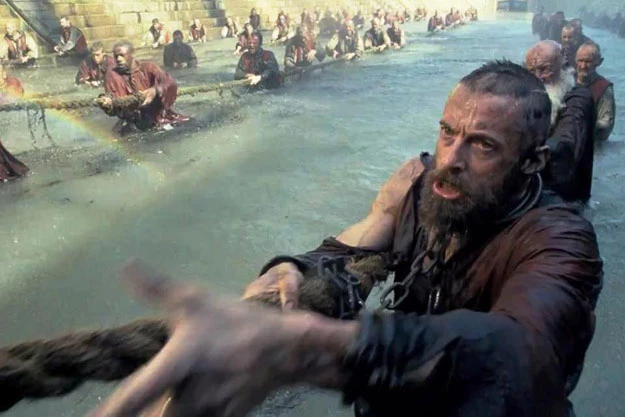 |
| Jean Valjean's teeth tell us there was no dental insurance in the French Revolution. |
 |
| Edward Redmayne (Marius) has leading-man teeth! |
I also really appreciated the make-up effects. Again, the
authenticity and immediacy were paramount here. One thing that struck me really
strongly was the teeth! Turns out most of the actors who had to have bad teeth –
(even rich people had bad teeth in the pre-dentistry days) – had thin veneers
made specifically for them that just fit over their real teeth. That was
particularly effective. However, you can ALWAYS tell the romantic lead in a
movie by his perfect and perfectly white teeth. (Hello, Edward Redmayne) Here is
an interesting interview
of the make-up supervisor for the film. I like what she has to say about
building a character and how that philosophy shows in her discussion of Sascha
Baron Cohen’s make-up plan.

One by one…
Jean Valjean/Hugh Jackman
| Hugh Jackman is no stranger to Broadway. |
I went into the viewing knowing Jackman’s credentials from
his time on Broadway in Boy
from Oz. And he certainly did not disappoint. His performance was nothing
less than ---- well --- EPIC. The scene in the convent at the beginning moved
me so deeply. Jackman showed us both Valjean’s inner struggle and his transformation
so clearly but to HEAR him doing this with his voice is what made it for me. It’s
not that he is an actor who sings or a singer who can act, he is acting with
his singing voice.
This made for such a strong contrast with …
| Russell Crowe/Inspector Javert |
Inspector Javert/Russell Crowe:
I was expecting to cringe while listening to Russell Crowe
sing. I didn’t. Actually, he wasn’t half bad in terms of technique. The sounds he was
making were absolutely unobjectionable if you ignore a little gruffy vocal fry
every now and again (which I found easy to do). No, what was lacking in his performance
was any sort of understanding of how to be musical. How to express an idea
through music and melody and words at the same time. I remember thinking during
“Stars” (which, incidentally, is a REALLY moving song and really hard to mess
up emotionally) that someone needs to tell Russell Crowe that scooping to every
note is not the same thing as being musical. Unfortunately for Crowe, the
directing style of the movie was really about static shots (when he wasn’t
changing camera focus quickly to another actor - but I digress) that allowed the
emotionality of the music and the actor’s singing to take center stage. Well,
since Crowe didn’t really have much of that, his acting appeared wooden and
one-dimensional. We have all seen him do more than this as an actor. Sadly, his
lack of vocal/musical expressive ability prevented us from really seeing what
he could have done with this great character.
For another take on Javert that uses the musicality in the
score and melodic line, please listen to Norm Lewis – who ALSO
doesn’t do much on stage.
| Edward Redmayne/ Marius |
Marius/Edward Redmayne:
Here is an example of the opposite of the above, great
acting and musical expressiveness but PAINFUL vocal technique. His
Kermit-the-frog, constricted, closed-pharynx singing made my throat hurt and
watching him muscle his way through the score just made me tired watching him.
Here is an example where some good technique could also added SO MUCH this
performance. He was so sympathetic, so believable, so expressive, so musical,
but ouch.
| The Thessoniéres |
Thessoniéres
Monsieur Thessoniére/Sascha Baron
Cohen
Is there anyone less sympathetic than the innkeeper Thessoniére?
He is mean to Cosette. He steals from his patrons. He basically sells Cosette
to a perfect stranger. Yet, in the film, he is almost like-able as Baron Cohen
plays him. How is that even possible? I can’t even put my finger on it. I have
been sort of anti-Sacha baron Cohen since Borat since I felt like he was making
fun of people without their knowledge - taking advantage of people for the sake
of some cheap humor. But now? I think he might be a genius. There was a rumor
going around that he was going to play Freddie Mercury which I guess is
actually going to happen.
That will be something to watch.
Speaking of the Thessoniéres…
Madame Thessoniére/Helena Bonham Carter
She was fine. But haven’t we seen this same
character before from her?
Speaking of fine…
| Samantha Barks as Eponine |
Eponine/Samantha Barks
Samantha Barks was in the West End production of Les Miserables in London so I was
expecting a lot from her performance. Alas, it left me a little flat. She sang
really well. She was very expressive. There wasn’t one thing that I can put my
finger on that was lacking. I just didn’t care that much about her character.
And her song should be one of the showstoppers of the evening (or morning in my
case) but it just - - - wasn’t. Her whole character is sympathetic – she does
what she does for Marius whom she loves so much that even when it works
contrary to her own wants and needs, she does what will benefit him. We should
have been thrashing about on the floor in tears when she died.
I also really liked
| Aaron Tviet as Enjolras |
Enjolras/Aaron Tveit
Loved his voice. Loved the acting. Believed him. Wish he had
been on screen/stage more.
HATED
Big Cosette/Amanda Seyfried
Which surprised me because I loved her in Mamma Mia (film). Vocal flaws and all. Her
Cosette was another study in one-dimensionality and the part was too high for her to express anything other than
cheeps and squeaks. This part, more than any other in the show in my opinion,
requires a so-called “legit” singer. One reason is that is rests so dang high.
Unless you are a freak like Linda Eder, you can’t belt in that range. Even if
you could, it would completely change the nature of the character. Cosette
needs to grow up and become a woman through the course of the action. She goes
from “There is a castle on
a cloud” to “A heart full of love” in a very short time. We have to hear
that she has grown up by the sound of her voice. Otherwise, the story doesn’t
make as much sense from her point of view. In order to get that womanly quality
in the voice, we need to hear someone who has a well-developed head voice/head-mix
than has some strength in the upper register AND who knows how to modify a dang vowel in the upper register!
This is usually associated with a classical approach to vocalism. Preferably,
with some MT aesthetic/vowel choices as well, it would be (is) weird to hear an
opera singer in the middle of Les
Miserables. Amanda Seyfreid didn’t sound much different (in fact didn’t
sound as GOOD) as the little girl playing the child version of her character. So,
just like Russell Crowe and Edward Redmayne, she is limited in her ability to
portray this character fully.
This couldn’t be more UNTRUE for
Fantine/Anne
Hathaway,
If she doesn’t win a Best Supporting Actress Oscar for this
role someone needs to SUE THE ACADEMY. Anne Hathaway’s performance is
absolutely gripping. The scene which includes “I dreamed a dream” was brutally
honest, exceptionally immediate and completely authentic.
And done in one long shot.
Did you notice? There were no cutaways.
That was a perfectly
timed and honest performance that would hold up anywhere. Not only that, but
she sounded right. She expressed the music with her singing voice. As she said “…I
just decided to apply the truth to the melody and see what would happen….” It
was like a masterclass in how to do just that.
Loved her so much that I can hardly talk about why.
So there you go. My take on the 2012 film version of Les Miserables.
Monday, January 23, 2012
Susan Graham at Spivey Hall
Concert attendees at Spivey Hall had the privilege to hear a wonderful performance by opera star and mezzo-soprano, Susan Graham. The program was varied but seemed to have a general theme of "Songs about Ladies" with repertoire ranging from Purcell's The Blessed Virgin's Expostulation to an ending group of songs about ladies with "questionable moral compasses."
Howell voice students, these comments are for you:
Did you notice?
Ms. Graham's mouth changed shape quite a lot. At one point in the Purcell there was quite a long melisma which started in the lower register and went into the upper register and back down again. Her mouth changed slightly for almost every note change but the vowel did not change a bit to our ears. It stayed true and recognizable. This would be an excellent example of Vowel Modification. To put it simply, in order for the vowels to have the same acoustic pattern, the instrument has to change shape. (I feel sure you have heard this somewhere before.) That was a real live example.
Did you notice?
Even though much of the recital was in languages other than English and not many of us in the audience are fluent in all of the included languages, we could always tell that she was saying SOMETHING. Even if we didn't know exactly what it was, we could tell there was a meaning there. There were even a few verbal jokes that many of the audience members were able to understand through a combination of the singer's intent and the information in the program.
Did you notice?
Related to the above... Ms. Graham used quite a lot of hand gesture and even (gasp!) moved around the stage a good bit but none of it seemed staged or fake. The gestures were a natural part of her communication like she was "speaking with her hands" as they say. One specific example is the line "Il vole"in the Poulenc set. "Il vole" means "he flies (away) and she gestured as if she was showing us that he had flown.
Did you notice?
Ms. Graham didn't sing loudly the whole time. In fact, there were times when she sang VERY softly. Remember folks, that's all we've got. Loud/Soft, Dark/Light, High/Low
What did you notice???
Thursday, December 22, 2011
My favorite Christmas Song
My favorite Christmas song is "In the Bleak Midwinter." which is based on a text by English poet Christina Rosetti (1830 - 1894) and was set to music by Gustav Holst in the early 20th century.
Rosetti fell from public favor at the turn of the 20th century due to the rise of modernism and her clear Romantic sensibilities. Later readers began to appreciate her suppressed feminism and gift for prosody. What I like about this poem is not only the implied glory that Jesus would give up in order to be born as the "Son of Man" but the beauty of his earthly family's love and especially the love of his mother who "worshiped him with a kiss." But what always gets me about this poem is the last verse. Who am I to give a gift of any kind to this man? What could I possibly ever give that could be of any value? If I were a part of that original story as the shepherd or the wise man, I would have played my part but here I am thousands of years later. What could I possibly do to recognize this amazing gift? I can give only what I have - my heart.
In the bleak mid-winter
Frosty wind made moan;
Earth stood hard as iron,
Water like a stone;
Snow had fallen, snow on snow,
Snow on snow,
In the bleak mid-winter
Long ago.
Our God, heaven cannot hold Him,
Nor earth sustain,
Heaven and earth shall flee away
When He comes to reign:
In the bleak mid-winter
A stable place sufficed
The Lord God Almighty --
Jesus Christ.
Enough for Him whom Cherubim
Worship night and day,
A breastful of milk,
And a mangerful of hay;
Enough for Him whom Angels
Fall down before,
The ox and ass and camel
Which adore.
Angels and Archangels
May have gathered there,
Cherubim and Seraphim
Thronged the air;
But only His Mother
In her maiden bliss
Worshiped the Beloved
With a kiss.
What can I give Him
Poor as I am? --
If I were a Shepherd
I would bring a lamb,
If I were a Wise Man
I would do my part,--
Yet what I can I give Him, --
Give my heart.
Gustav Holst set the tune for the 1906 English Hymnal with the tune "Cranham." Later settings include a darker setting by Drake, and other choral settings by Benjamin Britten and others. Eric Thiman set the piece for solo voice and piano.
Gustav Holst version for Choir:
Harold Darke version Soprano and Tenor soli and choir:
The printed music scrolls along with the sound in this clip
Pop singers also love this song. Here is a James Taylor version of the song which keeps the same basic tune but adds a pop aesthetic under it with a drum set and some guitar and piano riffs. (One of the best things about this tune is that it still holds up under this kind of change!)
James Taylor:
The song also sounds great in a sort of country-celtic-bluegrass kind of feel. Fionnula O'Donnovan changes the tune a bit but it is still recognizable as the original tune.
Fionnula O'Donnovan:
The tune also works in a sort of indie singer-songwriter aesthetic. Here is Corrine May's version.
Corrine May:
Wednesday, October 5, 2011
Adele's vocal problems
First of all - I love Adele.
I really like her voice both in the sense of the sound and timbre she creates with her vocal instrument and in the way she "speaks" through her music. I like her music too. There is an intensity there that can survive the COUNTLESS times her song "Rolling in the deep" was played on every media outlet this summer. (It is really a great song and the way it builds is just genius.)
I am not even going to say "but" -
Her voice is fine. Some people might think that because I am a voice teacher and that I teach primarily "classical" vocal technique that I am going to take issue with the WAY that Adele sings. That I am going to criticize her vocal technique. Nope. Sure, she uses primarily chest voice and some classical voice teachers avoid "chest" voice like the plague. (I don't) Sure, she takes that chest dominant sound rather high. That's not a problem for me. Luciano Pavarotti took his chest voice pretty high too. It's cool. Yeah, there is a little raspy-ness in her sound. But it worked for her. And she is using a microphone for her primary amplification. I have no problem with that. (Unless she was going to try to sing "O mio Babbino caro" or something like that. Then we would have issues.)
Before you read what I want to say about her voice, first read HER words about the whole vocal fold hemorrhage thing. (By the way, a hemorrhage is a leaking blood vessel.) Something to know for background. Adele smokes. According to an interview, "up to 30 cigarettes a day."
http://www.adele.tv/blog/352/important-blog
I take issue with her statement that all this happened with her voice and she had to cancel "through no fault of my own."
Even setting the smoking issue aside, Adele ignored her vocal problems to her own peril. She says herself that she was aware her voice was not behaving as normal and yet she continued to perform in the same way. (Adele's music is not just some squeaky folk songs. This is intense, muscular stuff.) What is the definition of insanity? Performing the same actions repeatedly and expecting different results. Adele knew her voice was injured and probably had been told what had caused that injury yet she continued the exact same behavior and is now surprised at the result? Please.
Adele, a personal plea for the sake of all of us who love your voice and your personality and your "BIG"ness, Go work with a Singing Voice Specialist - a voice teacher who has special training in the rehabilitation of the SINGING voice. Not just a speech therapist who also knows a little bit about singing. Or even a speech therapist who sings him/herself. They are trained in the rehabilitation of the speaking voice and can be incredibly good at that. However, that does not mean that they can help you belt a D5 like you have in "Rolling in the deep" without hurting yourself. And let's be honest. How can you avoid that high belt? That is why we love you and what you clearly love about your own voice.
Then start working with a voice TEACHER (not a voice "coach") who can help you learn how to do what you do without hurting yourself. It might even be the same person as above. There are quality people out there who REALLY KNOW WHAT THEY ARE DOING and use fact-based teaching techniques that are grounded in vocal function and can help you maintain that power in your chest register without trying to fundamentally change your sound. They do exist. Somatic Voicework (tm) would be one place to start.
If you were an elite athlete and injured your knee, you wouldn't just wait until it healed, you would look at the fundamentals of how that knee worked so that the injury would never happen again. Well, you are a VOCAL ATHLETE and need the same attention.
And for crying out loud, QUIT SMOKING!!! That hot smoke full of irritants is probably what caused the inflammation in your vocal folds to begin with which resulted in the bleeding. Take this time to go back and get some training because you are amazing and I personally want to be able to listen to your musical voice for a really long time.
I really like her voice both in the sense of the sound and timbre she creates with her vocal instrument and in the way she "speaks" through her music. I like her music too. There is an intensity there that can survive the COUNTLESS times her song "Rolling in the deep" was played on every media outlet this summer. (It is really a great song and the way it builds is just genius.)
I am not even going to say "but" -
Her voice is fine. Some people might think that because I am a voice teacher and that I teach primarily "classical" vocal technique that I am going to take issue with the WAY that Adele sings. That I am going to criticize her vocal technique. Nope. Sure, she uses primarily chest voice and some classical voice teachers avoid "chest" voice like the plague. (I don't) Sure, she takes that chest dominant sound rather high. That's not a problem for me. Luciano Pavarotti took his chest voice pretty high too. It's cool. Yeah, there is a little raspy-ness in her sound. But it worked for her. And she is using a microphone for her primary amplification. I have no problem with that. (Unless she was going to try to sing "O mio Babbino caro" or something like that. Then we would have issues.)
Before you read what I want to say about her voice, first read HER words about the whole vocal fold hemorrhage thing. (By the way, a hemorrhage is a leaking blood vessel.) Something to know for background. Adele smokes. According to an interview, "up to 30 cigarettes a day."
http://www.adele.tv/blog/352/important-blog
I take issue with her statement that all this happened with her voice and she had to cancel "through no fault of my own."
Even setting the smoking issue aside, Adele ignored her vocal problems to her own peril. She says herself that she was aware her voice was not behaving as normal and yet she continued to perform in the same way. (Adele's music is not just some squeaky folk songs. This is intense, muscular stuff.) What is the definition of insanity? Performing the same actions repeatedly and expecting different results. Adele knew her voice was injured and probably had been told what had caused that injury yet she continued the exact same behavior and is now surprised at the result? Please.
Adele, a personal plea for the sake of all of us who love your voice and your personality and your "BIG"ness, Go work with a Singing Voice Specialist - a voice teacher who has special training in the rehabilitation of the SINGING voice. Not just a speech therapist who also knows a little bit about singing. Or even a speech therapist who sings him/herself. They are trained in the rehabilitation of the speaking voice and can be incredibly good at that. However, that does not mean that they can help you belt a D5 like you have in "Rolling in the deep" without hurting yourself. And let's be honest. How can you avoid that high belt? That is why we love you and what you clearly love about your own voice.
Then start working with a voice TEACHER (not a voice "coach") who can help you learn how to do what you do without hurting yourself. It might even be the same person as above. There are quality people out there who REALLY KNOW WHAT THEY ARE DOING and use fact-based teaching techniques that are grounded in vocal function and can help you maintain that power in your chest register without trying to fundamentally change your sound. They do exist. Somatic Voicework (tm) would be one place to start.
If you were an elite athlete and injured your knee, you wouldn't just wait until it healed, you would look at the fundamentals of how that knee worked so that the injury would never happen again. Well, you are a VOCAL ATHLETE and need the same attention.
And for crying out loud, QUIT SMOKING!!! That hot smoke full of irritants is probably what caused the inflammation in your vocal folds to begin with which resulted in the bleeding. Take this time to go back and get some training because you are amazing and I personally want to be able to listen to your musical voice for a really long time.
Tuesday, April 19, 2011
Once More With Feeling: Respect and Awareness - A Professional Behavior!
Once More With Feeling: Respect and Awareness - A Professional Behavior!: "Sunday musings... less an hour of sleep due to daylight savings time here on the east coast... Are you simply AWARE in your professional..."
Monday, February 14, 2011
What the fach?
A supplement to a guest lecture I gave on gender roles and the fach system in a Women and the Arts class at Clayton State University.
Lyric Mezzo-soprano
Cherubino from Mozart's Le Nozze di Figaro
Cherubino
Dramatic Mezzo-soprano
Carmen from Bizet's Carmen
Carmen
Soubrette
Zerlina from Mozart's Don Giovanni
Zerlina
Lyric Coloratura
Gilda from Verdi's Rigoletto
(Some would take issue with this classification. Sometimes a heavier voice is cast in this role)
Gilda
Dramatic Coloratura
Lucia from Donizetti's Lucia di Lammermoor
(This role is also cast according to taste. For example, this singer does not have the heavier, darker tone often associated with this role)
Lucia
Lyric Soprano
Michaela from Bizet's Carmen
Michaela
Dramatic/Spinto Soprano
Aida from Verdi's Aida
Aida
Dramatic Soprano
Turandot from Puccini's Turandot
Turandot
Lyric Mezzo-soprano
Cherubino from Mozart's Le Nozze di Figaro
Cherubino
Dramatic Mezzo-soprano
Carmen from Bizet's Carmen
Carmen
Soubrette
Zerlina from Mozart's Don Giovanni
Zerlina
Lyric Coloratura
Gilda from Verdi's Rigoletto
(Some would take issue with this classification. Sometimes a heavier voice is cast in this role)
Gilda
Dramatic Coloratura
Lucia from Donizetti's Lucia di Lammermoor
(This role is also cast according to taste. For example, this singer does not have the heavier, darker tone often associated with this role)
Lucia
Lyric Soprano
Michaela from Bizet's Carmen
Michaela
Dramatic/Spinto Soprano
Aida from Verdi's Aida
Aida
Dramatic Soprano
Turandot from Puccini's Turandot
Turandot
Tuesday, February 8, 2011
Tuesday, January 25, 2011
White with Color
I usually do not enjoy so-called "Renaissance" voices. I find them colorless and quickly lose interest. Recently in preparing for a lecture in Art Song Literature, I rediscovered Emma Kirkby who has a definite affinity for historical music. Somehow, her voice, though arguably "perfect" for Renaissance and Baroque music still managed to have color and depth. See/Hear for yourself.
Tuesday, September 28, 2010
Singing is complicated
I have long enjoyed Jeannie Lovetri's blog - this week's was really interesting. She makes a rather long list of all the things a singer is expected to do well. Then adds a few things for specific styles such as CCM, etc.
LoVetri Post: It's Complicated
As she says at the end - it's a wonder anyone is able get all this done!
LoVetri Post: It's Complicated
As she says at the end - it's a wonder anyone is able get all this done!
Friday, September 10, 2010
Musical Constipation
I experienced one of those "breakthrough" lessons with a student today. She performs a lot of commercial-type music and was feeling "emotionally constipated" (my phrase) by classical music. She had a change of heart with (of all things) "V'adoro pupile" from Giulio Cesare by Handel. If you know Handel, you will immediately wonder how a commercial singer found a "way in" to classical music in this way.
I reminded her that singers at this time were expected to "improvise" within these arias. That improvisation, in fact, was a big part of their training. It seemed as if my student was feeling constrained by her expectation that she should "only do what is on the page." While this is true, we reminded ourselves that the piece of paper with a lot of black dots is not music. It is merely the representation of music. MUSIC is what we are creating when we sing/play. The paper is merely our road map to re-creating what the composer had in his head. We are expected to bring something of our own creative powers to the table as well and, in a way, are meant to create the music every time as if we are making it up on the spot.
It was as if a light turned on in a different room in this student's brain! (My teacher, friend and mentor Gary Race would have said that she connected with her communicator!) And I can tell you that it was a different experience hearing her sing after that moment. She still had some technical issues with the passaggio and needed to further modify some of the top notes for optimal resonance. She could use a little work on her legato. But that is not the point. She SANG.
My question now is, where did this girl get the idea in the first place that she was supposed to sing "classical" music any differently than that??? I am not taking the blame for this personally because this is our second semester working together and I have been trying to convince her to do this the entire time. But she got the idea somewhere. Was it my predecessor? I doubt that she specifically told this student that she ought to sing "classical" music in a way that was so emotionally rigid. Do we have a culture of constipation? If not, do our students think we do? Where do they get that idea?
I will grant that studying something academically has an inherent danger of sucking the life right out of it. But it isn't a foregone conclusion. Is it?
Below, I include a youtube clip from a production of Giulio Cesare in which Danielle de Niese gives a stellar performance as Cleopatra and sings the aria discussed above. The production was a Bollywood-inspired version of the story and got rave reviews from just about everyone. Ms. de Niese is admittedly not my favorite singer and this staging is a little strange out of context but one thing you CANNOT say is that her performance is boring.
Now - who do we know who is not boring AND sings beautifully at the same time? Hmmmmmmm.....
I reminded her that singers at this time were expected to "improvise" within these arias. That improvisation, in fact, was a big part of their training. It seemed as if my student was feeling constrained by her expectation that she should "only do what is on the page." While this is true, we reminded ourselves that the piece of paper with a lot of black dots is not music. It is merely the representation of music. MUSIC is what we are creating when we sing/play. The paper is merely our road map to re-creating what the composer had in his head. We are expected to bring something of our own creative powers to the table as well and, in a way, are meant to create the music every time as if we are making it up on the spot.
It was as if a light turned on in a different room in this student's brain! (My teacher, friend and mentor Gary Race would have said that she connected with her communicator!) And I can tell you that it was a different experience hearing her sing after that moment. She still had some technical issues with the passaggio and needed to further modify some of the top notes for optimal resonance. She could use a little work on her legato. But that is not the point. She SANG.
My question now is, where did this girl get the idea in the first place that she was supposed to sing "classical" music any differently than that??? I am not taking the blame for this personally because this is our second semester working together and I have been trying to convince her to do this the entire time. But she got the idea somewhere. Was it my predecessor? I doubt that she specifically told this student that she ought to sing "classical" music in a way that was so emotionally rigid. Do we have a culture of constipation? If not, do our students think we do? Where do they get that idea?
I will grant that studying something academically has an inherent danger of sucking the life right out of it. But it isn't a foregone conclusion. Is it?
Below, I include a youtube clip from a production of Giulio Cesare in which Danielle de Niese gives a stellar performance as Cleopatra and sings the aria discussed above. The production was a Bollywood-inspired version of the story and got rave reviews from just about everyone. Ms. de Niese is admittedly not my favorite singer and this staging is a little strange out of context but one thing you CANNOT say is that her performance is boring.
Now - who do we know who is not boring AND sings beautifully at the same time? Hmmmmmmm.....
Sunday, August 22, 2010
The Aging Voice in the Church Choir
Over the weekend I had the immense pleasure of teaching a class called “The Aging Voice in the Church Choir” at the SC Baptist Convention’s Worship Summit at White Oak conference center in Winnsboro, SC. This valuable conference gives church worship staff members the opportunity to take classes which will benefit them directly in church ministries. These classes ranged from how to use a sound board to Introduction to Finale music writing software to modulation on the organ to keeping control of a children’s choir.
The class I taught focused on the challenges faced by the leader of a choir which contains a significant number of aging voices. So often, worship leaders “give up” on aging voices and either write them off as unimportant and irrelevant in the wider church music ministry or simply resign themselves to the status quo, never hoping for any improvement in the basic vocal instruments at hand. Of course, neither of these scenarios is appropriate or accurate. While the aging voice does face important challenges, there are specific and practical techniques which a choir leader can employ to significantly improve the performance outcome.
Above is a copy of the presentation I gave which I include for the purposes of sharing with those who attended as well as with those who did not. Please note, the above is simply the slideshow that I presented along with the lecture. There is no sound. As always, if you have any questions please feel free to contact me.
The class I taught focused on the challenges faced by the leader of a choir which contains a significant number of aging voices. So often, worship leaders “give up” on aging voices and either write them off as unimportant and irrelevant in the wider church music ministry or simply resign themselves to the status quo, never hoping for any improvement in the basic vocal instruments at hand. Of course, neither of these scenarios is appropriate or accurate. While the aging voice does face important challenges, there are specific and practical techniques which a choir leader can employ to significantly improve the performance outcome.
Above is a copy of the presentation I gave which I include for the purposes of sharing with those who attended as well as with those who did not. Please note, the above is simply the slideshow that I presented along with the lecture. There is no sound. As always, if you have any questions please feel free to contact me.
Monday, July 5, 2010
Audition 101
Here is what I tell my students about auditioning.
1. Be prepared. Music.
This means having music memorized, music marked clearly for accompanist, having a point of view about the character. The assumption here is that you have already worked out the technical aspects of any piece that you offer for an audition and won't have to worry about that at all. An audition for a role is very different from a singing competition or an audition for entrance into a program where voice is everything. You want to present a complete package here.
2. Be prepared. Dress.
Dress appropriately. You don't want to be remembered for how you dressed for your audition - either in a good way or a bad way. You want them to remember your performance. People have VERY different ideas about what is appropriate for an audition. I have a friend who insists that all her female students wear stockings any time they sing.
This is certainly a place to use your best judgment based on specific information you might have. However, when in doubt, wear something conservative that flatters your own shape.
3. Be prepared. Information.
Know what the company wants to cast. If possible, know the upcoming season and which roles might be right for you. Bring audition repertoire that reflects an awareness of this information. People have differing opinions about whether or not to offer something from one of the shows being produced. Use your best judgment here.
4. Be prepared. Know what the company wants to hear.
In other words, be prepared with the information and repertoire that the company specifies in the audition announcement. If they say they want 16 bars of a piece of music - offer 16 bars. This is especially important for those who are used to doing opera auditions (which traditionally hear more singing) who are participating in a musical theater audition (which traditionally hear comparatively little singing). If a monologue is requested, find and prepare a spoken monologue. If a dance portion of the audition is specified, bring appropriate attire for a dance audition.
5. Be prepared. You might not get the part you want.
You might be offered a different part than you anticipated. Know before you audition whether or not you can accept larger/smaller roles. The company representatives may ask you at the audition and it is considered bad form to misrepresent yourself here.
You might not be offered a role at all. Remember, this doesn't mean that the company didn't like you or didn't think you were worth casting. It may be that they liked you but just don't think you are right for anything that they have available this season.
Are you sensing a theme here?
1. Be prepared. Music.
This means having music memorized, music marked clearly for accompanist, having a point of view about the character. The assumption here is that you have already worked out the technical aspects of any piece that you offer for an audition and won't have to worry about that at all. An audition for a role is very different from a singing competition or an audition for entrance into a program where voice is everything. You want to present a complete package here.
2. Be prepared. Dress.
Dress appropriately. You don't want to be remembered for how you dressed for your audition - either in a good way or a bad way. You want them to remember your performance. People have VERY different ideas about what is appropriate for an audition. I have a friend who insists that all her female students wear stockings any time they sing.
This is certainly a place to use your best judgment based on specific information you might have. However, when in doubt, wear something conservative that flatters your own shape.
3. Be prepared. Information.
Know what the company wants to cast. If possible, know the upcoming season and which roles might be right for you. Bring audition repertoire that reflects an awareness of this information. People have differing opinions about whether or not to offer something from one of the shows being produced. Use your best judgment here.
4. Be prepared. Know what the company wants to hear.
In other words, be prepared with the information and repertoire that the company specifies in the audition announcement. If they say they want 16 bars of a piece of music - offer 16 bars. This is especially important for those who are used to doing opera auditions (which traditionally hear more singing) who are participating in a musical theater audition (which traditionally hear comparatively little singing). If a monologue is requested, find and prepare a spoken monologue. If a dance portion of the audition is specified, bring appropriate attire for a dance audition.
5. Be prepared. You might not get the part you want.
You might be offered a different part than you anticipated. Know before you audition whether or not you can accept larger/smaller roles. The company representatives may ask you at the audition and it is considered bad form to misrepresent yourself here.
You might not be offered a role at all. Remember, this doesn't mean that the company didn't like you or didn't think you were worth casting. It may be that they liked you but just don't think you are right for anything that they have available this season.
Are you sensing a theme here?
Thursday, June 24, 2010
Aaaaaaaaahhhh - geek out!
To call the last few days a major geek out is an understatement. I have had the best time delving into about 50 cds I checked out of the library in preparation for teaching an Art Song Literature class. I have enjoyed some old favorites like
Elly Ameling:
Dietrich Fischer-Dieskau
Anne Sofie von Otter:
Olaf Bar
And new favorites such as
Gerald Finley - (wish I could have found an Art Song, but this is a great clip from Doctor Atomic)
Susan Graham:
Thomas Quasthoff:
And have even discovered some new jewels:
Bo Skovhus
(who I had heard about and seen but to whom I had yet to listen)
Solveij Kringelhorn:
Elly Ameling:
Dietrich Fischer-Dieskau
Anne Sofie von Otter:
Olaf Bar
And new favorites such as
Gerald Finley - (wish I could have found an Art Song, but this is a great clip from Doctor Atomic)
Susan Graham:
Thomas Quasthoff:
And have even discovered some new jewels:
Bo Skovhus
(who I had heard about and seen but to whom I had yet to listen)
Solveij Kringelhorn:
Friday, June 11, 2010
Getting Ready
Putting together a fun, interesting and creative recital is a challenge. Really. So-called "Academic" recitals are relatively easy. One must include certain elements in order to fulfill academic requirements. Western European languages must all be represented. Usually these recitals go in chronological order of composition. Each section is united by some element, most commonly the composer, sometimes just the language.
During the course of my student career I put together and performed approximately 10 recitals. (2 undergraduate, 2 Master's, 2 Professional Studies, 4 Doctoral) You would think that I would be more confident in my expertise at this. Alas, you would be wrong!
It is June and my first faculty recital at Clayton State University is in October. The theme is "A Woman's Life and Love" (remind you of Schumann?") The sections will be as follows:
Daughter
Sister
Mother
Lover
Looking forward to writing about each as we go.
During the course of my student career I put together and performed approximately 10 recitals. (2 undergraduate, 2 Master's, 2 Professional Studies, 4 Doctoral) You would think that I would be more confident in my expertise at this. Alas, you would be wrong!
It is June and my first faculty recital at Clayton State University is in October. The theme is "A Woman's Life and Love" (remind you of Schumann?") The sections will be as follows:
Daughter
Sister
Mother
Lover
Looking forward to writing about each as we go.
Monday, March 15, 2010
Gerald Finley, my new hero
So, I have a new hero. His name is Gerald Finley. He is a baritone. I was privileged to see and hear his recital yesterday at Clayton State's Spivey Hall. He sang Schumann Heine settings, Ravel Nature Songs, Barber songs and some Ives songs.
First the Schumann. To say that his diction was superb is simply not enough. It wasn't just that his diction was so good or that he sang really beautifully. Finley communicated the songs in a way that was simply - well, - clear. That is the best word for it. I understood the words, but more importantly, I understood the story. I can't think of a better compliment than that. Finley uses his voice at the service of the text BUT he never sings less than beautifully. How I loved it!
At the end of the recital, I looked at my watch and sincerely believed that only an hour had passed when really, it was twice that.
THEN
He gave a master class for our students at Clayton State. here are some quotable quotes.
“You sort of have a personal angle on the piece”
“The energy is not just in the making of noise but in the activity of communicating.”
“You’ve given me a beautiful picture and we’re gonna’ take the puzzle pieces out and put it back together.”
Breath – “not stopped by your throat but (moving) through your throat”
“You like to bloom into the sound – don’t be cautious, its much more satisfying for us to hear the beginning of the tone.”
“I’m gonna pretend that I’m tired but I’m still gonna SING!”
Breath – “it’s like punctuation”
“Piano is beautiful – not soft. --- So pianissimo is even MORE beautiful. Never sing anything less than beautifully.”
“Once you start the sound, there’s no going back.”
“What is bloom? It is allowing the breath to travel a little more luxuriously.”
“These (abdominal muscles) will be your friends for life. These (vocal folds) will only be your friends as long as you treat them well.”
First the Schumann. To say that his diction was superb is simply not enough. It wasn't just that his diction was so good or that he sang really beautifully. Finley communicated the songs in a way that was simply - well, - clear. That is the best word for it. I understood the words, but more importantly, I understood the story. I can't think of a better compliment than that. Finley uses his voice at the service of the text BUT he never sings less than beautifully. How I loved it!
At the end of the recital, I looked at my watch and sincerely believed that only an hour had passed when really, it was twice that.
THEN
He gave a master class for our students at Clayton State. here are some quotable quotes.
“You sort of have a personal angle on the piece”
“The energy is not just in the making of noise but in the activity of communicating.”
“You’ve given me a beautiful picture and we’re gonna’ take the puzzle pieces out and put it back together.”
Breath – “not stopped by your throat but (moving) through your throat”
“You like to bloom into the sound – don’t be cautious, its much more satisfying for us to hear the beginning of the tone.”
“I’m gonna pretend that I’m tired but I’m still gonna SING!”
Breath – “it’s like punctuation”
“Piano is beautiful – not soft. --- So pianissimo is even MORE beautiful. Never sing anything less than beautifully.”
“Once you start the sound, there’s no going back.”
“What is bloom? It is allowing the breath to travel a little more luxuriously.”
“These (abdominal muscles) will be your friends for life. These (vocal folds) will only be your friends as long as you treat them well.”
Friday, March 12, 2010
I recently had the immense pleasure of seeing my college friend Elizabeth Bishop (not the poet) sing the role of Amneris in Verdi's Aida with Atlanta Opera. Here is my gush:
What an absolute pleasure it was to hear her singing so beautifully and musically! How she uses her voice as an integral part of her acting. How healthy she sounds. How her vibrato is spot on - not to wide, not to shallow. (this is a pet peeve of mine)
I loved her characterization of Amneris as NOT a shrieking harpy - as is sometimes so easy to do. But as a woman who is unaccustomed to not getting what she wants, who genuinely loves Radames and can only direct her hurt and anger towards the only source she can think of. I love that she also heard in Verdi's music that Amneris ultimately makes peace with the lovers (although admittedly she DID sort of "win" ha!) and is really the only character who grows and changes over the course of the story. If I were telling this story, Amneris would be MY focus. By all accounts, she is technically the protagonist!
But I just can't say enough about how beautiful she sounded. I wish every one of my students could have heard her sing.
What an absolute pleasure it was to hear her singing so beautifully and musically! How she uses her voice as an integral part of her acting. How healthy she sounds. How her vibrato is spot on - not to wide, not to shallow. (this is a pet peeve of mine)
I loved her characterization of Amneris as NOT a shrieking harpy - as is sometimes so easy to do. But as a woman who is unaccustomed to not getting what she wants, who genuinely loves Radames and can only direct her hurt and anger towards the only source she can think of. I love that she also heard in Verdi's music that Amneris ultimately makes peace with the lovers (although admittedly she DID sort of "win" ha!) and is really the only character who grows and changes over the course of the story. If I were telling this story, Amneris would be MY focus. By all accounts, she is technically the protagonist!
But I just can't say enough about how beautiful she sounded. I wish every one of my students could have heard her sing.
Subscribe to:
Posts (Atom)